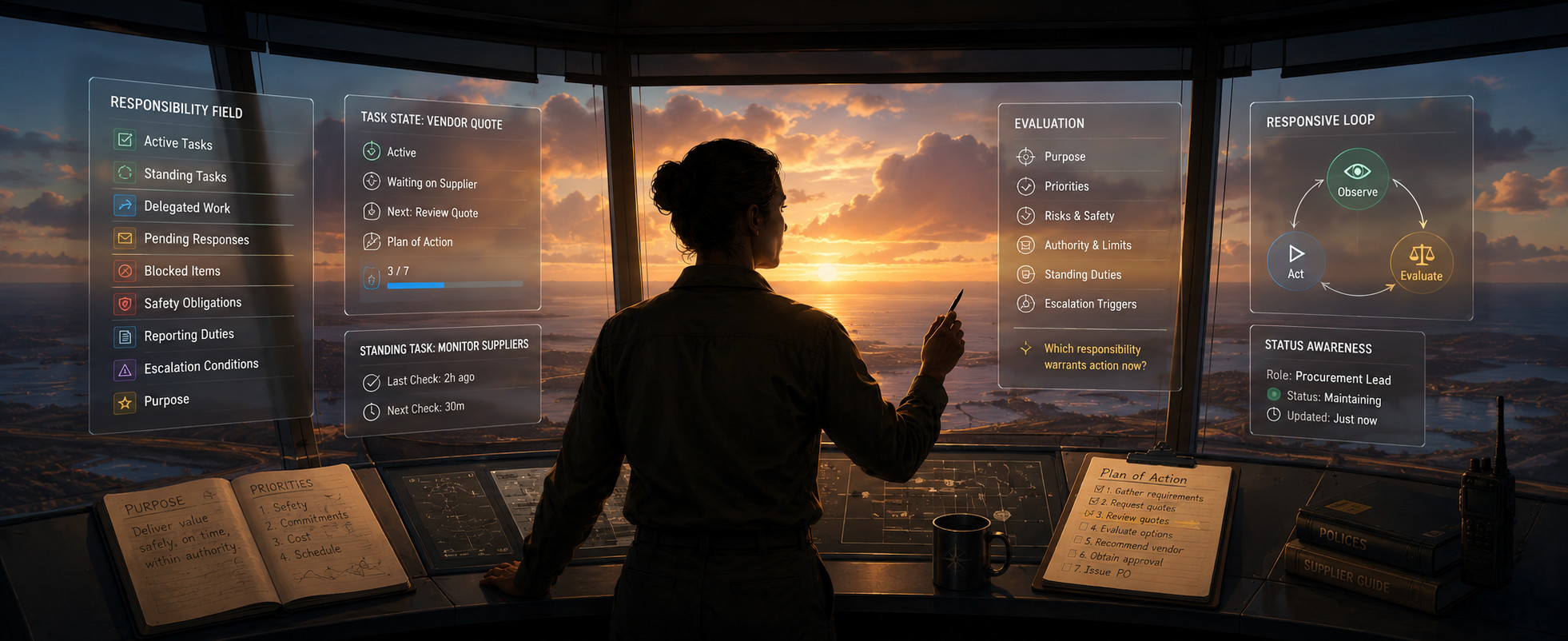
The task-management chapter established that a role becomes executable when its work can be understood as tasks. The plan-of-action chapter established that a task becomes performable when the performer forms a working sequence of actionable items. This chapter establishes the balancing act that keeps focused task execution responsible: the performer may act through the focused task, but evaluation remains governed by the held role.
A performer cannot act on every responsibility at once.
A role may contain many responsibilities and governing conditions: active tasks, standing tasks, pending messages, delegated work, blocked items, safety obligations, reporting duties, authority limits, escalation conditions, and the larger purpose the role exists to serve. At any given moment, one responsibility may have focus, but the rest of the role has not disappeared.
The performer must judge which responsibility warrants the next action.
This judgment happens in the evaluation phase of the responsive loop. Observation notices the current condition of the role. Evaluation determines what the condition means inside the role. Action performs the next move that evaluation has judged responsible.
Evaluation is therefore not merely selection. It is judgment under constraint. The performer evaluates the live moment against the purpose, authority, standards, priorities, limits, and standing duties of the role being held.
The Task Has Focus, but the Role Governs
A focused task supplies the immediate work. It brings its task state into attention: the current condition of the task, the plan of action, actionable items, open questions, blocked items, delegated items, pending responses, recent changes, and the next apparent step.
The held role supplies the governing responsibility. It defines what the work is for, what authority the performer has, what standards apply, what standing duties remain active, what risks matter, what must be reported, what requires consultation, and what conditions require escalation or pause.
The task may ask, what should be done next for this task?
The role asks, is that next move responsible within the role I am holding?
Responsible execution requires both questions. Without task focus, the performer surveys responsibilities without moving the work forward. Without role governance, the performer may move the focused task forward while neglecting the larger responsibility that gives the task its meaning.
The Responsibility Field
The role defines a responsibility field: the responsibilities and shared role conditions the performer must hold while the role is active.
Role tasks organize the work the role requires. The responsibility field includes those tasks, but also includes the governing conditions that determine how those tasks should be evaluated.
The responsibility field includes the task currently in focus, but it is larger than that task. A standing task remains in the field even when it is not the focus. A delegated task remains in the field as a pending responsibility until its status is known or its result is returned. A blocked task remains in the field because the missing condition still matters. A safety obligation remains in the field whether or not the focused task is about safety. An escalation condition remains in the field because the performer may encounter its threshold at any moment.
The responsibility field may also contain role-level information that affects more than one task. Authority limits, schedule pressure, safety conditions, available resources, pending messages, changes in local conditions, and instructions from the level above may all shape how tasks are evaluated. This information belongs to the role because it governs more than one task at a time.
The responsibility field may include shared operational state, but that state supports evaluation; it does not replace procedure. A performer may know something useful from the broader responsibility field, but each task is still performed according to the role, the task's plan of action, and the procedures that govern the task.
Task State
Each task has a task state from the moment it enters the role, even when that state is minimal: assigned, not yet started, and not yet understood beyond the responsibility the role has received.
Task state is the current operational condition of a task. It answers the practical question: where does this task stand right now?
For a non-standing task, the state may be that the task has not started, is ready, is active, is blocked, is pending, is delegated, is suspended, is complete, or needs revision. For a standing task, the state may be that the standing condition is being maintained, that it has not been attended to recently enough, that something inside it now requires attention, or that held-readiness has been lost.
The plan of action is part of the task state, but the two are not identical. The plan of action gives the task a working path. The task state says where the task currently stands along that path, what has changed, what is waiting, what is blocked, what is ready, and whether the plan still fits.
A task state may be simple enough to hold in memory. It may be no more than the performer's current understanding of the next step. A larger task may need notes, a checklist, a ticket, a shared document, or a status report. The tool is not the discipline. The discipline is that the performer maintains enough current state to evaluate the task responsibly.
Status Awareness
A responsible performer maintains status awareness for the role.
Status awareness is not a separate artifact. It is the performer's maintained understanding of where the role and its tasks stand. It is the internal condition that makes an accurate status report possible, whether or not a formal report is produced.
A ticketing system, clipboard, notebook, whiteboard, checklist, shared document, or memory may all serve this function at different scales. Each makes task state durable, structured, visible, or recoverable in its own way. The same operational state exists whether or not a formal system is present.
The role always has operational state. The only question is where that state is held, how durable it is, how visible it is, and whether it is current enough to support responsible evaluation.
A performer who cannot account for the state of the role cannot justify the next action responsibly. Focus is accountable when the performer can explain why this responsibility deserves attention now, given the state of the other responsibilities the role is holding.
Maintaining the responsive loop is the universal standing task inside every role. This standing task includes the actions needed to keep the responsibility field current: observing changes, updating task states, checking standing responsibilities, noticing interrupts, preserving status awareness, and keeping the role ready to act.
When the performer updates the responsibility field, the performer is not acting outside the task hierarchy. The performer is carrying out the standing task that keeps the role active.
The Order of Assessment and Evaluation
Role-governed evaluation can be described as a practical order of attention.
First, the performer assesses the state of each task. Which tasks are ready, active, blocked, pending, delegated, suspended, complete, or in need of attention? Which standing tasks are being maintained? Which standing tasks require attention now?
Second, the performer assesses the responsibility field as a whole. What responsibilities are currently being held? What shared role conditions matter? Has anything changed in the role's environment, authority, safety condition, schedule pressure, or standing obligations? Is additional information needed before the role can continue responsibly?
Third, the performer evaluates the status of each task. A task's state does not speak for itself. A pending task may be fine if the role is simply waiting for a response. A pending task may require follow-up if the response window has passed. A blocked task may be acceptable if the block is known and harmless. A blocked task may require escalation if the block prevents the role from meeting its purpose. A standing task may be stable. A standing task may need attention because it has not been checked recently enough.
Fourth, the performer evaluates the status of the role. Is the role being held responsibly? Are the standing duties covered? Is the performer still inside authority? Is the role overloaded? Is information missing? Has a condition appeared that requires consultation, escalation, delegation, reporting, pause, or stop?
Fifth, the performer evaluates which responsibility warrants action next. The answer may be to continue the focused task, shift focus to another task, return to a task whose blocked condition has cleared, attend to a standing task, report status, consult, escalate, delegate, gather missing information, revise task state, or stop.
Sixth, the performer locates the selected responsibility inside the relevant task context and re-evaluates that task's plan of action. Does the current plan still fit the task state? Is the next item still ready? Has a dependency changed? Has new information altered the plan? Does the task still fit inside the role's authority, standards, and limits?
Seventh, the performer evaluates which actionable item or act should be performed next within that task. The selected act is not justified merely because it appears in the plan. It is justified because the task state, the responsibility field, and the held role still support it.
This order is logical, not ceremonial. In familiar work, the whole movement may collapse into a moment of judgment. In complex, unfamiliar, or high-stakes work, the same movement may need to become explicit.
Evaluation as Judgment Under Constraint
Evaluation is the phase where judgment meets governance.
The role constrains evaluation without replacing judgment. The performer supplies judgment without escaping the role.
The authored role gives the performer purpose, authority, standards, priority rules, limits, procedures, escalation paths, and standing responsibilities. These do not mechanically determine every next action. They define the frame within which judgment operates.
The performer brings attention, interpretation, timing, local awareness, training, experience, and the ability to recognize when the authored role does not fit the live situation cleanly.
Responsible evaluation balances both. Rigid compliance can execute a written instruction while violating the role's larger purpose. Unconstrained improvisation can respond to local conditions while abandoning the continuity the role was created to preserve. Role-governed evaluation holds the middle: faithful to the authored role, responsive to the live moment.
Choosing the Next Responsibility
In practice, evaluation is often simple.
The performer assesses the responsibilities being held at that moment and judges which one warrants the next action. This often means taking a quick glance across task states and the responsibility field: which task is active, which task is pending, which task has become unblocked, which task is waiting on a response, which standing task needs attention, and which responsibility has the strongest claim now.
A receptionist updating a calendar while holding the front desk may continue the calendar task until the phone rings. The ringing phone enters the responsibility field with enough urgency to displace the focused task. The receptionist answers the phone, handles the call, then returns to the suspended task if the task state still shows it as ready.
A foreman sourcing a switch for a broken drill press may continue comparing supplier options while an important task is waiting on a supplier response. That is not neglect. It is task management inside role-governed evaluation: the pending task remains visible in the responsibility field, but attention moves to work that can proceed. If a worker then reports a safety concern on the floor, the safety concern belongs to the held maintenance and shop-floor role. It may outrank both sourcing and the pending task, even if sourcing was the active focus a moment earlier.
A teacher helping one group recover its project may continue that focused work until another student reports an injury. The injury changes the responsibility field. The teacher's role governs evaluation, and the next responsibility is no longer the project consultation.
Each case has the same shape. The focused task matters, but it does not own the performer. The role owns the responsibility field. Evaluation determines which responsibility now deserves action.
Interrupts and Displacement
An interrupt is an event that enters the responsibility field with enough authority to displace the current focus.
Not every new event is an interrupt. Some events can be queued. Some can wait. Some can be ignored because they do not belong to the role. Some become new tasks but do not outrank the focused task. Others require immediate attention because the role's governing responsibilities give them priority.
The difference is not merely that the event is loud, recent, or emotionally salient. The difference is whether the role's governance makes the event action-worthy now.
A phone ringing at the front desk is an interrupt because answering calls is part of the receptionist's standing task. A random noise outside may not be. A fire alarm is an interrupt because safety responsibilities outrank most focused work. A casual question may be queued unless the role or situation makes it urgent.
Interrupt handling is therefore role-governed evaluation under pressure. The performer judges whether the event displaces focus, waits in queue, becomes a task, requires delegation, or falls outside the role entirely.
Failure of Evaluation
A role is only executable if its performer can determine, moment by moment, which responsibility warrants action next.
Evaluation fails when the performer cannot determine which responsibility warrants action, or determines incorrectly.
That failure may come from poor local judgment. A performer may ignore a responsibility they should have recognized, overreact to a responsibility that could have waited, or choose an action the role did not authorize.
But the architectural cause is often upstream. The role may not define the responsibility field clearly enough. The governing rules may not establish how competing responsibilities should be weighed. The role may contain too many standing duties for one performer to hold. The authority limits may be vague. The escalation conditions may be missing. The standards may be unclear. The input script may assume judgment, training, or context the performer does not possess.
Evaluation failure is not always a defect in the performer. Sometimes it is the moment when the role encounters an edge case the authored governance did not yet cover. In that case, the failure becomes information the orchestration can use to revise the role, clarify priorities, add escalation conditions, or redistribute responsibility.
When a performer chooses the wrong responsibility for action, the first inspection should not be the performer's character. It should be the structure the performer was asked to operate inside.
The question is architectural: did the role give the performer enough governance to evaluate the moment responsibly?
Authored Governance and Local Judgment
Focused task execution depends on the balance between authored governance and local judgment.
Authored governance gives the performer a role that can be held. It defines responsibilities, priorities, standards, limits, and escalation paths clearly enough that the performer can evaluate the current moment without inventing the role from scratch.
Local judgment lets the performer apply that governance to actual conditions. The performer reads the moment, recognizes what matters, notices when a condition has changed, senses when a plan has become unsafe or wasteful, and knows when the role's own rules require consultation or escalation.
The plan of action may be coherent. The actionable items may be concrete. The next act may be obvious. But the act is still responsible only if it remains aligned with the task, the task remains aligned with the role, and the role's other responsibilities have not produced a stronger claim on action.
Good rules cannot replace judgment in live conditions. Good judgment cannot compensate indefinitely for a poorly authored role. The lower levels of decomposition make work performable. The higher levels keep that work accountable.
Execution moves downward into acts. Responsibility remains governed upward by the role. The performer does not escape the role by focusing on a task. The performer carries the role into the task, evaluates the task through the role, and acts only when the next act remains responsible inside the role's governing structure.
Role-Governed Evaluation
Role-governed evaluation is the discipline that keeps focused execution responsible.
The performer holds the role, maintains status awareness, assesses task states and the responsibility field, evaluates what those states mean, chooses the responsibility that warrants action, re-evaluates the relevant plan of action, and performs the next act that remains responsible inside the role.
This is how a role remains active while a task has focus.
This is how task execution avoids tunnel vision.
This is how authored governance and local judgment meet in performance.