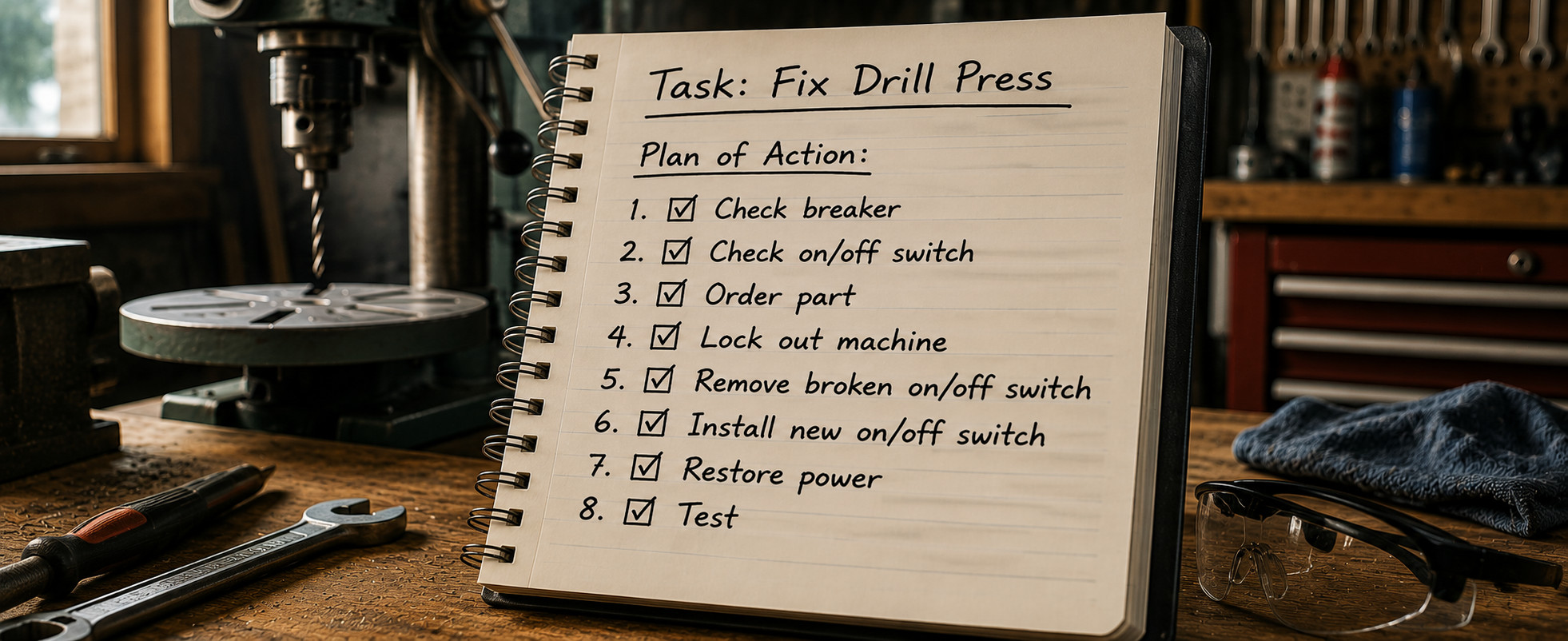
The task-management chapter established that a role becomes executable when its work can be understood as tasks. This chapter follows one task into performance. A task becomes performable when the performer forms a plan of action for it: a working sequence of actionable items, grounded in the role and revised as execution reveals what the task requires.
A task does not become performable merely because it has been assigned.
Assignment gives the performer responsibility. It does not yet give that responsibility a path through time. The performer still has to determine how the task should begin, what actions belong to it, what order those actions require, what information is missing, what task state must be tracked, and how the work should change as the task unfolds.
A task becomes performable when the performer forms a plan of action for that task.
A plan of action is the performer’s current understanding of how the task should proceed. It gives the task a working sequence of actionable items. It names what can be done now, what must wait, what depends on something else, what needs more information, and what should happen next.
The plan is not fixed at the moment it is created. It remains open to revision as execution reveals the task more clearly. The performer acts, observes what changed, evaluates whether the plan still fits, and adjusts the plan when adjustment is needed.
The Task Is Not the Plan
A task names work the role requires.
A plan of action names how the performer currently understands that work should be carried out.
The distinction matters because the task can remain stable while the plan changes. A foreman assigned to repair a drill press still has the same task if the first sourcing path fails. The task remains: restore the drill press with minimum disruption to active work. The plan changes: the foreman may move from the listed supplier to another supplier, consult the owner, or choose a different replacement path.
The task names responsibility. The plan of action organizes that responsibility into a path the performer can act on.
The Plan Belongs to the Task
A role may contain many tasks. Each task may need its own plan of action.
Task management keeps the role coherent. A plan of action keeps an individual task performable.
Role state may summarize a task. Task state explains it. The role may know that the drill press repair is waiting on part acquisition. The plan of action for the repair carries the details: which part was identified, which supplier was contacted, which response is pending, which option was approved, and what should happen next.
Performing the Task in Character
A task is performed inside a role. The performer may bring one task into focus, but the role remains the character being played.
The task supplies the immediate work. It carries the plan of action, current state, actionable items, open questions, blocked items, delegated items, pending responses, and next responsible act.
The role supplies the purpose, authority, standards, standing responsibilities, and limits within which the work is performed. It also names the conditions under which the performer should report, consult, escalate, pause, or release the role.
The actor performs the task in character. A foreman sourcing a switch for a drill press is not merely sourcing a switch. The foreman is performing the maintenance role while sourcing the switch: restoring the tool with minimum disruption, staying within authority, preserving safety, and consulting when uncertainty exceeds the role.
When attention moves from one task to another, the immediate task changes. The role remains. The performer sets down one task context and brings another into focus, but the role continues to govern what responsible action means.
Giving the Task a Sequence
Performance happens through time. The performer may keep many things in view, but action still occurs through acts. One act happens before another. Some acts can occur in any order. Some acts can occur in parallel when delegated to different performers. Some acts cannot happen until another act has already happened.
A plan of action gives the task its shape through time.
The order does not come from a template imposed from the outside. It comes from the work itself. Some acts logically depend on prior acts. Shoes cannot be tied before they are put on. A repair cannot be tested before it is made. A part cannot be installed before it is acquired. A message cannot be delivered before it is addressed.
Logical order is not a planning template. It is one of the conditions that makes action possible.
The performer forming a plan of action identifies the actions the task appears to require and reasons about how those actions relate.
The plan of action does not need to be elaborate in every case. For a simple task, the plan may be held in memory and last only a few seconds. For a larger task, the plan may need to be written down, revised, shared, or reported. The form varies with the work. The need for a working sequence does not.
Forming the Plan
A performer forms a plan of action by drawing several kinds of judgment together.
The performer identifies the actionable items the task appears to require.
The performer looks for existing guidance: the input script, standing procedures, examples, prior notes, instructions from the role, or any other source the task makes relevant.
The performer draws on training and experience. Training gives the performer known patterns for turning responsibility into action. Experience gives the performer remembered patterns from previous work: what usually happens, where tasks tend to break down, what signals matter, what shortcuts are safe, and what requires caution.
The performer may consult another participant when the task exceeds local certainty, authority, skill, or available information. Consultation may confirm the current plan, alter it, add missing context, or reveal that the task should be escalated.
The performer may research. Research supplies missing information that neither the input script nor the performer’s current understanding provides. Research may mean reading a manual, checking a policy, searching records, inspecting a part number, reviewing prior notes, or looking up an outside source.
As these sources come together, the performer reasons about order. Which action comes first? Which action depends on another? Which action can happen now? Which action should wait? Which action would be unsafe, wasteful, or irresponsible until something else is known?
A plan of action forms where instruction, training, experience, consultation, research, and local conditions meet.
The performer does not merely copy the input script. The performer interprets the task under actual conditions.
Actionable Items
Actionable items are the visible surface of the plan of action.
An actionable item is concrete enough that the performer can tell what doing it would mean. “Figure out the drill press” is weak because it does not yet name an act. “Check whether the breaker is tripped” is stronger. “Test continuity through the switch with power off” is stronger. “Call the supplier and ask whether the compatible switch is in stock” is stronger.
An actionable item is not defined by size. It is defined by performability. The performer can tell how to begin, what the item is for, and when the item has been carried far enough for the plan to continue.
A performer may keep several actionable items in view, but active attention rests on one item at a time. When attention leaves an item, the plan of action must preserve enough state for the performer to return to it without losing their place.
Actionable items are where interpretation reaches performance. They turn the performer’s understanding of the task into acts the performer can carry out.
The First Plan Is a Starting Path
The first plan of action is not a promise that the task will unfold as imagined.
It is the performer’s best current path into the task.
The first plan is formed from what is known at the time. It may be simple, incomplete, and partly uncertain. That does not make it defective. A plan only needs to be strong enough to begin responsibly. More will be learned as action proceeds.
The performer may discover that an assumption was wrong, an item is blocked, a dependency was missed, a needed resource is unavailable, a safer path exists, a step is unnecessary, or the task is larger than first understood. None of these discoveries means the original plan failed. They mean the task is being encountered.
Responsible performance expects revision. The plan of action changes because the work reveals what the performer could not know before acting.
State Assessment
As execution progresses, the performer assesses the state of the task.
State assessment is the observation phase focused on the task’s current condition. It notices what has changed, what has been completed, what remains open, what is blocked, what is ready, what has been delegated, what is waiting on a response, what questions remain unresolved, and what local conditions now matter.
State assessment also preserves continuity. The performer needs enough current state to pause the task and return to it without losing their place. If pausing a task would force the performer to reconstruct it from scratch, the task state is not being preserved well enough, unless the task is so small that reconstruction costs nothing.
The amount of state that must be preserved depends on the task. A small task may require only memory. A larger task may require notes, a checklist, a shared document, a ticket, a written plan, or a status report. The tool is not the discipline. The discipline is keeping enough task state available that the performer can continue responsibly.
A plan of action therefore carries more than future steps. It carries the current condition of the task as execution changes that condition.
Re-Evaluating the Plan
State assessment feeds evaluation.
The performer observes the task’s current state, then asks whether the current plan still fits. Is the next action still the right next action? Is an item now blocked? Did a dependency appear? Did research change the facts? Did consultation change the judgment? Did a completed action make another action ready? Did local conditions shift? Does the task still fit inside the role’s authority?
This is the responsive loop focused on the plan of action.
The plan of action is maintained by the same loop that governs all role performance. Observation assesses task state. Evaluation tests whether the plan still fits that state. Action either carries out the next item or changes the plan so the task can continue responsibly.
Even when one task has focus, the performer is still holding the role. Evaluation therefore tests whether the task’s plan of action fits the task’s current state and remains consistent with the role’s purpose, authority, standards, and limits.
For the active task, evaluation asks whether the next action can responsibly continue the task or whether the task now requires revision, research, consultation, delegation, escalation, pause, clarification, or stop. These moves are part of tending to the active task because they arise from the task’s current state.
Revising the Plan
A plan of action may change in many ways.
- An item may be marked complete.
- An item may become blocked.
- An item may be added.
- An item may be removed.
- An item may be reordered.
- A task may split into subtasks.
- A delegated item may become pending.
- A consultation point may be added.
- A research need may appear.
- An escalation condition may be reached.
- A task may be paused.
- A task may be stopped.
A plan of action that cannot change becomes brittle. A plan of action that changes without reasoning becomes unstable. Responsible revision requires both state assessment and evaluation. The performer changes the plan because something in the task state warrants the change.
Revision preserves alignment between the task as first understood and the task as it is now being encountered.
When the Plan Reveals a Limit
A good plan of action does not only tell the performer what to do next. It also reveals when the performer should not continue without help.
The plan may reveal missing information, missing judgment, more work than one performer can carry, insufficient authority, ambiguity in the assigned task, or risk. The performer may need research, consultation, delegation, escalation, clarification, pause, or stop.
This is not a breakdown of performance. It is part of responsible performance. A performer who recognizes the limit of the current plan is preserving the task’s connection to the role, the input script, and the larger purpose the task serves.
A plan of action is therefore not merely a way to proceed. It is also a way to discover when proceeding would no longer be responsible.
Adaptive Task Execution
The plan is not created once and then merely followed. It is formed, used, tested, revised, and carried forward. The responsive loop keeps it current enough for the performer to act responsibly.
This is how task execution stays adaptive. The performer does not need a special method to make the task adaptive. The performer needs a plan of action, state assessment, reasoning, and the willingness to revise the plan when the task state shows that revision is needed.
Making the Task Performable
A plan of action is not a checklist pasted onto a task. It is the performer’s current working understanding of how the task should proceed, kept current as execution reveals what the task requires.
A task that has no plan of action is only assigned.
A task with a plan of action can begin.