I spent the better part of half a day reintroducing myself to the fundamentals of linear algebra (LA). I have to admit that the experience feels far more engaging this time around, largely because the subject matter now seems grounded in real purpose. I watched the first four class sessions of the popular introductory MIT YouTube series on linear algebra by Professor Gilbert Strang—specifically, his course MIT 18.06 Linear Algebra (available via MIT OpenCourseWare).
I'd forgotten much of the basics I learned in college, as I rarely applied this level of mathematical rigor during my 26 years in software development. When I asked Grok about it, I learned that the "Four Fundamental Subspaces" (covered in Lecture 10 of the series) are important for better understanding the KV cache in large language models. So far, everything I've read confirms that grasping these four subspaces is pivotal—Gaussian pun intended.
One thing that immediately struck me about the pure math involved in LA is the realization that my initial assumption about possible operations that might reveal information about the latent space and pairwise embeddings is more than likely incorrect.
In the wake of that realization, one quiet design pattern from decades of engineering work started to resurface even more clearly. It had been running in the background throughout this series, quietly connecting disparate domains. I call it the waypoint design pattern: using a sparse set of discrete instructions (waypoints) to guide, navigate, or enable rich, complex behavior.
The SwiftUI “views are values” moment felt like a brick — abstract and ungrounded. Trying to understand it led me down a long path of deconstruction using my own past experiences. Along the way, this same pattern kept quietly resurfacing across completely different domains and decades of work. In a way, this entire article series has become its own set of waypoints — markers of discovery guiding me through the shifting terrain of analogy and latent structure.
In grad school, long before I thought of myself as a software developer, my first C program that wasn’t coursework was a deterministic “random” masking experiment. I used a lagged Fibonacci generator to create a byte stream and treated it as an external reference path. I then computed deltas (input_byte − mask_byte) as corrective instructions, hoping the residuals would be small and compressible. Technically this was delta encoding against a pseudorandom predictor, not true waypoint navigation. It mostly failed — random data has high entropy — but the loose instinct was already there: maybe I could use an external scaffold plus corrective signals to navigate data more efficiently.
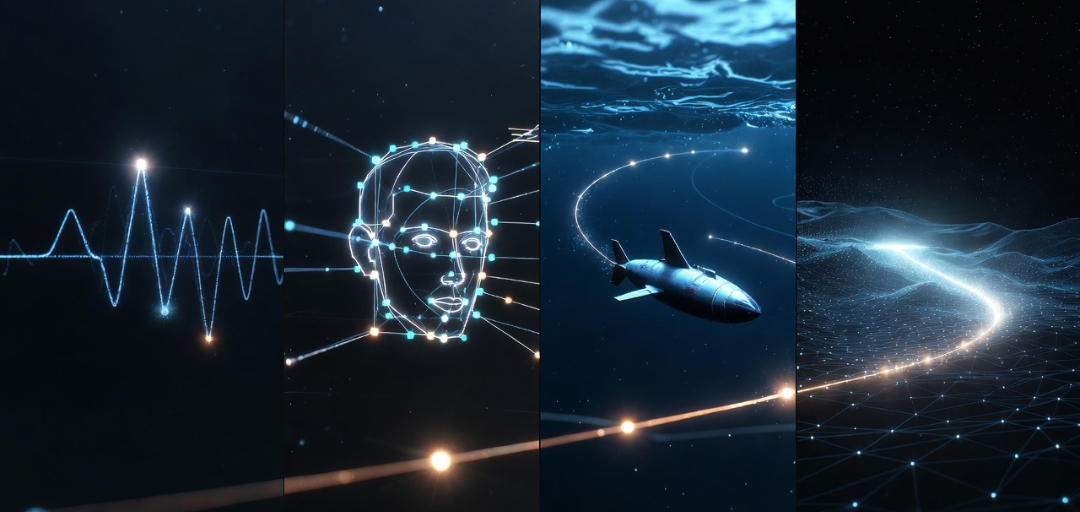
Years later, while building the FaceMakr avatar app, I created a custom render engine that reduced rich vector drawings to a minimal set of normalized coordinates and a small number of CoreGraphics drawing primitives — almost all of them Bézier path and line instructions. These sparse control points and path commands became the waypoints.
The satisfying, fluid scrolling experience came from smoothly traversing those compact waypoint instructions. A handful of Bézier control points could define complex, natural-looking curves with very little data. The waypoints carried the essential shape and direction, while the rendering system filled in the smooth, analog feel through interpolation.
Even earlier, while working with audio in QuickTime and later AVFoundation, I often wondered whether Bézier paths could be used to compress analog audio signals. The idea was simple in concept: approximate smooth waveforms using a sparse set of control points instead of storing every sample. At the time I assumed it was just a personal hunch.
Years later I learned that this intuition was actually a researched and practical technique. Researchers have used quadratic and cubic Bézier curves (and related spline methods) for lossy compression of audio waveforms, motion-capture data, and other analog signals. The sparse control points act as efficient waypoints that capture the essential shape and curvature of the signal, while interpolation reconstructs a smooth approximation. It was another quiet confirmation that the waypoint pattern had broader applicability than I realized.
The pattern showed up most clearly and recently in the last three years working on custom flight controllers for an autonomous mini submarine (AUV) project. Waypoint navigation was at the absolute core of the system.
We worked with sparse sets of 3D waypoints that had to be turned into trajectories the vehicle could actually follow underwater — dealing with drag, unpredictable currents, limited actuator power, and strict energy constraints. The challenge was always the same: keep the discrete waypoint instructions as minimal as possible while still producing smooth, stable, and efficient motion. Currents acted as constant perturbations that required real-time course corrections.
This wasn’t abstract theory. It was practical engineering with real trade-offs between sparsity, smoothness, robustness, and energy use.
The quiet mental map that has been running in the background throughout this series:
Once this pattern came into focus, the parallel to large language models became hard to ignore.
Embeddings and the KV cache increasingly feel like high-dimensional waypoint instructions — compact relational positions in the latent manifold. Generation feels like navigating a trajectory guided by those waypoints, with attention mechanisms handling the real-time responses and corrections. Analogy, in this view, happens when waypoint sequences from distant domains align well enough to allow a smooth, structure-preserving glide between them.
The Kernel Reduction Operator (KRO) helped bring this into sharper focus. By stripping descriptions down to their minimal lossless seeds, KRO repeatedly revealed sparse kernels that still enabled faithful expansion and cross-domain bridging — very much like distilling a complex path down to its essential waypoints.
Interestingly, some recent work in generative modeling (such as Waypoint Diffusion Transformers) uses intermediate semantic waypoints as anchors to help guide and disentangle complex generation trajectories. This resonates with how I’ve been thinking about using KRO-reduced kernels as sparse relational anchors to instrument cleaner cross-domain analogical mappings in the latent substrate.
I’m very aware that this framing might simply reflect my own particular background more than any deep truth about latent space. After all, I’m an engineer who once built Fibonacci masks that taught me hard lessons about entropy, shipped a cartoon avatar app, and spent years trying to keep miniature submarines from misbehaving underwater.
Still, the waypoint pattern has shown up too consistently across too many domains — and KRO kept bringing me back to it — for me to ignore it completely. So I’m putting the idea out there, with all its limitations.
If this waypoint design pattern resonates with you, or helps spark better ways to think about analogy in the latent substrate, I’d love to hear your thoughts. If it doesn’t land, that’s perfectly fine too — the exploration itself has already been valuable.