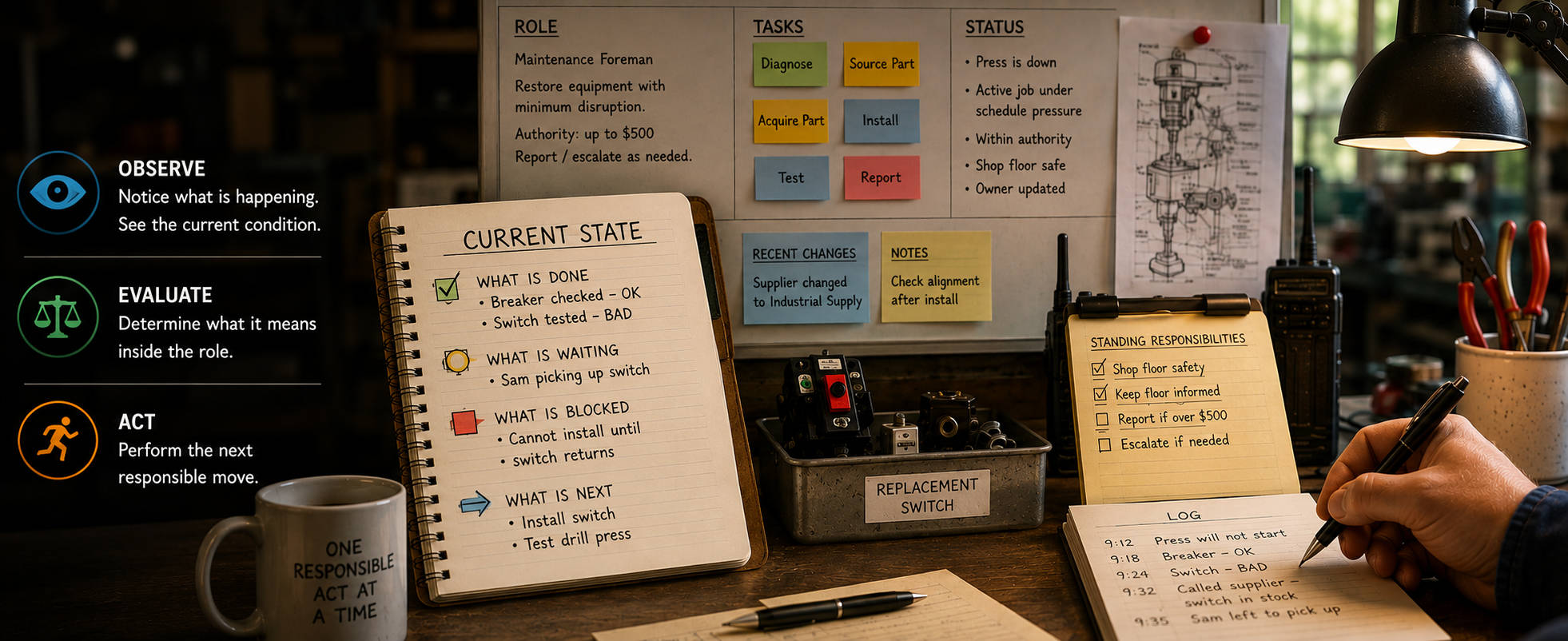
The delegation chapter established that responsibility can be entrusted to a participant who accepts a role. The task-management chapter established that a role becomes executable when its work can be understood as tasks. The plan-of-action chapter established that a task becomes performable when the performer forms a working sequence of actionable items. The role-governed evaluation chapter established that the performer chooses the next responsibility from the responsibility field. The systematic-execution chapter established that responsible execution depends on maintaining the process by which the next act is selected. This chapter names the discipline that makes those judgments possible: keeping tabs on where things stand.
A performer cannot act responsibly from nowhere.
The performer must know the current condition of the role, the task, the plan, and the surrounding responsibilities well enough to judge what should happen next. Some of that knowledge may be held in memory. Some may be written in notes. Some may be preserved in logs, forms, tickets, checklists, or reports. The surface varies with the work. The requirement is the same: the current state of the work must be available for responsible evaluation.
State management is the discipline of keeping tabs on where the work stands.
The phrase is ordinary because the act is ordinary. A foreman repairing a drill press keeps tabs on which checks have been completed, which part failed, which supplier has the replacement, who is picking it up, whether the machine is still down, and what should happen when the part arrives. A teacher running a classroom keeps tabs on which groups are progressing, which students are stuck, which questions are waiting, and which duties still require attention. A supervisor running a shift keeps tabs on active work, standing responsibilities, pending reports, safety conditions, and the state of the team.
State Is Where the Work Stands
State is not merely what happened. State is where the work stands because of what happened.
A log entry may say that the breaker was checked at 10:15. The state of the repair is that the breaker has been ruled out as the cause of the drill press failure. A message may say that the supplier has the switch in stock. The state of the task is that a replacement path is available. A note may say that Sam left in the shop truck. The state of the procurement task is that the replacement is being picked up and the repair is waiting on Sam's return.
Events matter because they change state. Observations matter because they reveal state. Records matter because they preserve state. Evaluation uses state because the performer's next judgment depends on where the work stands now.
State may include what has been done, what remains open, what is blocked, what is waiting, what has changed, what is unsafe, what is unclear, what has been delegated, what has been completed, and what appears next. The list is not fixed. Different roles require different kinds of state. The discipline is not to maintain every possible detail. The discipline is to maintain enough of the current condition of the work that the next judgment can be made responsibly.
Role State and Task State
The broadest state a performer holds is the state of the role itself. Is the role still active? Are the standing duties being maintained? Is the performer still inside the role's authority? Are the role's standards still being honored? Has the role become overloaded? Has something changed that requires consultation, escalation, delegation, reporting, pause, or release?
A foreman holding the maintenance role may know that the drill press remains down, the active job is under schedule pressure, the repair is still within authority, the shop floor remains safe enough for other work to continue, and the owner has approved use of the replacement supplier. That is role state. It describes the condition of the responsibility the foreman is holding.
Each task inside the role also has state. A task state answers the practical question: where does this task stand right now?
The drill press repair task may stand like this: breaker checked and fine; switch failed continuity test; replacement switch approved; Sam is picking it up; installation has not started; next action is to install and test when Sam returns. That is task state. It does not describe the whole role. It describes one responsibility inside the role.
The distinction does not need to become a heavy taxonomy. The point is simple: the performer must know where the role stands and where the active tasks stand. Without that current understanding, evaluation becomes guesswork.
Mental Notes
Record keeping begins in memory.
A mental note is a weak form of record keeping. The performer preserves state internally: remember that Sam is picking up the switch, remember that the supplier changed, remember that the next paragraph needs revision, remember that the approval has not come back yet. For small, immediate, uninterrupted work, a mental note may be enough.
A mental note keeps state alive only as long as the performer can keep holding it.
That makes mental notes fragile. They can be lost through interruption, fatigue, distraction, time, stress, competing responsibilities, or handoff. A performer may believe they will remember a detail and then discover later that the state has vanished. The task must then be reconstructed from memory, repeated work, new inspection, or guesswork.
Mental notes are not wrong. They are simply not very durable. The more likely the work is to be interrupted, resumed later, handed off, reviewed, audited, or acted on by another participant, the less sufficient memory becomes.
Mental notes are also not portable state. Memory is local to the performer. It does not travel to another participant, cannot be inspected by a supervisor, cannot be resumed by a replacement, and cannot be relied on by someone who was not present when the state was formed. A foreman may remember that Sam is picking up the switch, but Jess does not know that unless the state is communicated. A teacher may remember which group is stuck, but a substitute cannot continue from that memory. A supervisor may remember a safety concern, but the next shift cannot inherit it unless the state has been made durable.
When state must survive beyond one performer's immediate attention, memory is no longer enough. The state has to move into a portable surface: a note, a log, a checklist, a ticket, a report, a message, or some other record the relevant participants can access and interpret.
Record Keeping
Record keeping is the ordinary working discipline of making state durable.
The simplest record is a note. A note may be informal and still be sufficient if it preserves where the work stands. More formal records develop when the work needs more durability, consistency, visibility, or review.
- A written note moves state out of memory so it can survive interruption.
- A descriptive note preserves enough context that the note can be understood later.
- A log preserves events and observations in sequence.
- A form prompts the performer to capture specific information consistently.
- A checklist preserves known steps and their completion state.
- A ticket or case record holds the evolving condition of work that may be updated, handed off, escalated, resumed, or closed.
These are not different disciplines. They are different surfaces for the same discipline: preserving enough state that responsible action can continue.
A scientific log makes the purpose of a log obvious. The point is not only to remember that work happened. The point is to preserve what was observed as the work unfolded, so later judgment can see what changed, what remained stable, and how the current condition came to be. Maintenance logs, medical charts, security logs, operations logs, and field notes all do similar work in their own domains.
Durability
State has a durability gradient.
A mental note is least durable. A written note survives outside memory. A log preserves sequence. A form prompts consistent capture across performers. A ticket or case record can carry the current condition of the work through updates, ownership changes, escalation, and closure.
The right amount of durability depends on the work.
A person walking to the next room to grab a tool may need only a mental note. A foreman coordinating a two-hour repair may need a few written notes and a receipt. A hospital shift handoff needs records that survive changes in staff. A maintenance program for hundreds of machines needs logs and forms. A legal proceeding needs records that can be reviewed long after the original participants have left the room.
The more likely the work is to be interrupted, resumed, handed off, reviewed, audited, or disputed, the more durable its records need to be.
Durability is not formality for its own sake. Durability is what lets state survive the conditions the work will encounter.
Descriptiveness
State also has a descriptiveness gradient.
A vague note may remind the original performer what they meant, but it may not help anyone else. It may not even help the original performer after enough time has passed.
A weak note says:
Switch issue.
A stronger note says:
Drill press will not start. Breaker checked and fine. Switch failed continuity test. Replacement switch needed.
A more descriptive note says:
Drill press is down. Breaker checked and fine. Jess confirmed line voltage reaches the switch but does not pass through it, and continuity fails with power off. Local supplier has compatible aftermarket switch in stock. Owner approved use of new supplier. Sam is picking it up. Next step: install and test when Sam returns.
The third note is not more sophisticated because it uses a special format. It is more useful because it preserves more of the state needed to continue the work responsibly.
If a note might be misunderstood, make it more descriptive.
That is the practical rule. A note does not need to follow a formal schema in every case. It needs to preserve the current condition of the work clearly enough for the next performer, including the performer's future self, to interpret it without reconstructing the whole situation from scratch.
Current Enough to Trust
A record can be durable and descriptive and still fail if it is stale.
A stale record preserves what used to be true after the work has moved on. A checklist that has not been updated may show a task as pending after it is complete. A note may say the supplier has not answered after the reply has already arrived. A ticket may say the task is blocked after the missing part has been delivered. A plan may show a next step that is no longer safe, useful, authorized, or necessary.
Stale state is dangerous because it looks like knowledge. The performer acts as if the record describes the current condition of the work, when it only describes an earlier condition.
Keeping records current is therefore part of the work. Updating a note, marking a task complete, recording a result, revising a next step, or correcting an obsolete assumption is not administrative decoration. It is state management.
State that cannot survive interruption is not durable enough. State that cannot be understood is not descriptive enough. State that is no longer current is not safe enough to govern action.
State Changes Through Acts
Every act can change state.
Checking a breaker changes the state of a diagnosis. Receiving approval changes the state of authority. Waiting past a response window changes the state of a pending request. A teacher answering a student's question may change the state of a group's project. A supervisor moving a worker to another station may change the state of the shift. Recording a result changes the state available to future evaluation.
Some acts change the visible work directly. Some reduce uncertainty. Some preserve the state for later evaluation. Some bring another participant into the responsibility. Some report state outward. Some pause, stop, resume, or close a task. The categories are less important than the effect: the act changes where the work stands or changes what can be known about where it stands.
The performer observes the change, updates the state as needed, evaluates the new condition, and selects the next responsible act.
State and Evaluation
Evaluation depends on state.
The performer cannot judge whether to continue, wait, consult, escalate, delegate, revise the plan, report status, or stop unless the performer knows where the work stands. Bad state produces bad judgment. Missing state produces guesswork. Stale state produces misplaced confidence.
This does not mean the performer must eliminate all uncertainty before acting. Judgment is always made against available state and governing criteria, and both may be incomplete. Unknown failure modes remain possible. A responsible act may still fail because the criteria were incomplete, the assumptions were wrong, or the work revealed something no one had known to look for.
Operational confidence does not mean certainty. It means the performer has enough current state, authority, and alignment with the role's criteria to act responsibly despite remaining unknowns.
Uncertainty becomes action-shaping when the performer recognizes that the current state is not sufficient to support the next act. At that point, the responsible move may be to inspect, check, ask, consult, research, verify, record, wait, escalate, or otherwise change the state before continuing.
State management does not make performance infallible. It makes performance accountable to what is currently known.
Status
Status is state prepared for communication.
The performer may hold more state than another participant needs. A status report selects the part of the state that matters to the recipient: what has been done, what is blocked, what is waiting, what changed, what risk has appeared, what decision is needed, or what completion has been reached.
Reporting status does not create the state. It makes state visible. A performer who has not maintained state cannot report status accurately without reconstructing the work. A performer who has maintained state can communicate the current condition of the work in the form the coordination requires.
Status may be brief:
Switch failed. Replacement approved. Sam is picking it up. Repair resumes when he returns.
Or it may be formal:
Drill press repair is in procurement. Diagnosis complete: breaker ruled out, switch failed continuity test. Owner approved local supplier. Replacement switch in pickup. Machine remains down. Next step is installation and test after part arrival.
The difference is calibration. The performer reports enough state for the recipient to understand what they need to understand.
Keeping Tabs on Things
State management is the ordinary working discipline of keeping tabs on things.
A performer keeps tabs by preserving the current condition of the role and its tasks well enough that responsible action can continue. Sometimes memory is enough. Sometimes a note is enough. Sometimes the work requires logs, forms, checklists, tickets, reports, or formal records.
The surface is chosen according to the work's need for durability, descriptiveness, visibility, and review.
The discipline is simple but not optional.
A role cannot be performed responsibly when the performer has lost track of where things stand.
Keeping tabs is how the role remains accountable to time.