The role-playing chapter established the discipline through which participants take on roles and react within them, and named three foundational reacting capabilities: responding to requests, reacting to current conditions, reporting status. The boundary-conditions chapter established that some operations have an input boundary but no delivery — they end by stopping rather than by producing a completion, and their interior is the running of the role itself rather than the production of any finished thing. This chapter names what is running inside any role being played. The architectural component is the responsive loop, and it is what makes role-playing operate across time rather than only as a single transaction.
Six Posts
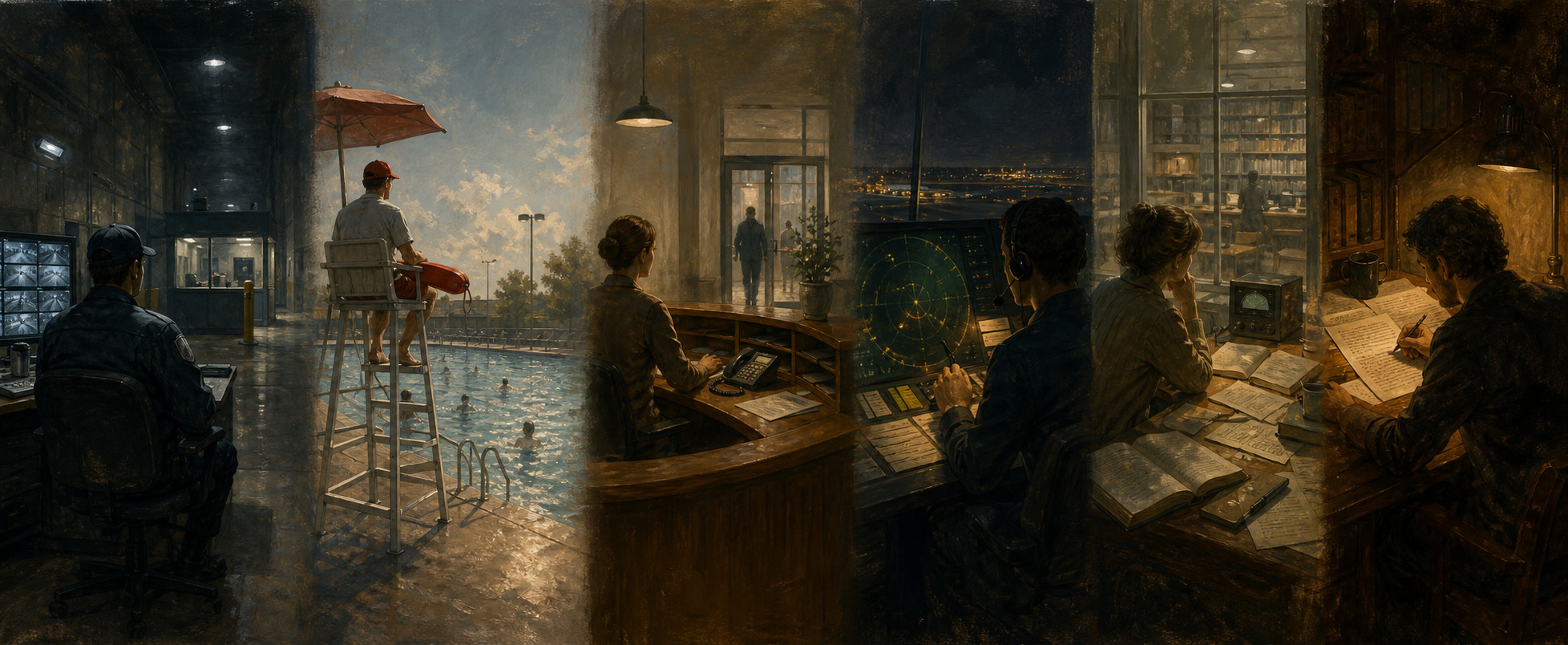
A security guard is on the overnight shift at a warehouse. The guard alternates between two modes of work. For the first part of the shift, the guard walks rounds — a route through the building and the perimeter, stopping at specific stations to check that doors are locked, windows are intact, and nothing has changed since the last pass. For the second part, the guard sits at a station with monitors showing camera feeds from across the property and scans the feeds, attending to motion, to the alarm panel, to anything that doesn't match what the property normally looks like at this hour. The guard moves between the two modes on the schedule the post requires. Across an entire shift the guard may encounter nothing — no intruders, no alarms, no incidents of any kind — and the shift will still have been worked, the post will still have been held, and the work the guard was hired to do will still have been done.
A lifeguard is at a public pool during open hours. The lifeguard sits on an elevated chair where the whole pool is visible and watches the swimmers. The watching has a specific shape — the lifeguard's eyes move across the pool in a pattern, attending to each section, looking for the patterns of distress the lifeguard has been trained to recognize. Most of the time the swimmers are fine, and the lifeguard's work is the watching itself. When something does require action, the lifeguard acts immediately and decisively, because the time window for effective response in a drowning is short. After the action, when the situation is stable, the lifeguard returns to the watch.
A receptionist is at the front desk of an office. The phone may ring. A visitor may walk in. A delivery may arrive. A colleague may stop by with a question. An email may arrive that requires attention. Between events, the receptionist may be working on other tasks at the desk — sorting mail, updating a calendar, reading something the role permits. When an event occurs, the receptionist sets aside whatever else they were doing and handles it. When the event is handled, the receptionist returns to whatever they were doing before, or to whatever else the desk requires next.
An air traffic controller is at a sector position in a control facility. Aircraft enter the sector, traverse it, and hand off to the next sector. The controller is in continuous contact with the aircraft on their frequency, watching their positions on the radar, anticipating conflicts, issuing instructions, coordinating with adjacent controllers, accepting handoffs from upstream sectors and giving handoffs to downstream ones. The work is dense with procedure — standardized phraseology, defined separation requirements, specified handoff protocols — and the procedures run continuously through the shift. There is no part of the shift when the controller is not engaged with the work; the post consumes essentially all of the controller's attention while it is held.
A researcher is working on an investigation. The researcher reads literature, queries databases, gathers data from instruments or fieldwork, consults colleagues, exchanges drafts with reviewers, formulates questions, designs studies, runs analyses, drafts findings. The work proceeds through continuous interplay between the researcher's own thinking and the external sources the inquiry depends on — observing what has been gathered so far, evaluating what it implies and what gaps remain, acting by retrieving the next source, sending a question to a colleague, running the next analysis, writing the next paragraph, asking the next reviewer for feedback. The events the researcher attends to come from both directions — from the researcher's own cognition surfacing what the inquiry needs next, and from the responses, data, and writings that arrive when the researcher reaches outward. The work is the iteration of attention across both, with each cycle of retrieval and reflection producing what the inquiry calls for next.
An author is drafting a chapter. The author writes a sentence, reads it, evaluates whether it serves the work, writes the next sentence, reads what has accumulated, evaluates whether the paragraph is doing what it needs to do, revises a passage, drafts forward, returns to revise again. The writing emerges through cycles of attending to what has been written so far and reacting with the next move. The author is not waiting for events to arrive; the author is producing events through the work, with each sentence becoming an observation the next evaluation operates on. The composition takes its shape through extended reaction to itself.
What Is Common Across the Six
The six posts look different. The settings differ, the events differ, the reactions differ, the proportion of the role player's attention the post consumes differs, the visible activity differs. The first four lean toward events arriving from outside — swimmers, callers, aircraft, anomalies on a camera feed. The researcher works on events from both directions — internal cognition surfacing the next question, and external literature, data, colleagues, and reviewers providing what the inquiry needs. The author works largely on events the work itself produces — sentences read becoming the next observation, gaps in the draft prompting revision. What is common is the architectural shape of what the role player is doing while the role is held. Observation runs continuously, attending to whatever the role specifies, with the events coming from whatever sources the role draws on. Evaluation operates on what observation has produced, when the role player reasons about it. Action performs what evaluation has concluded, when capacity is available. The phases are independent operations with sequence dependencies — each runs on its own timing, but no action fires without prior evaluation, and no evaluation runs without prior observation. The architecture persists for as long as the role is held and terminates when the role is released.
This is the responsive loop. It is the temporal structure of role-playing in operation. Whenever a role is being played, the responsive loop is what is running. Role-playing is the thing — the architectural practice the framework named earlier. Playing a role is the act — what the role player is doing right now. The responsive loop is what is happening inside the act.
Phases
The observation phase is what the role player attends to. The role's specification names what falls within the role's attention. Observation runs continuously while the role is held, with the attention pattern matching what the role requires. The role's design implicitly determines how much of the role player's attention the observation phase consumes, and the design has consequences for what other activity the role player can undertake while the role is held. It is the orchestrator's job to balance the load each role player is asked to attend to — across the roles a single role player holds, and across the role players who together hold the orchestration's posts — so that no role player is asked to attend to more than the loops they are running can sustain.
The evaluation phase operates on what observation has produced. It determines what the observation means and what response it warrants. This is reasoning. The role player draws on the role's procedures, on training, on experience, and on judgment about the specific situation, and reaches a conclusion about whether action is required and what action would serve. Evaluation depends on observation — the role player has no basis for reasoning without information observation has produced — but evaluation does not have to happen the moment observation produces something. Evaluation runs on its own timing, when the role player turns attention to what was observed, with the depth calibrated to what the situation requires.
The action phase performs whatever the evaluation concluded was warranted. The action's specifics are determined by the role's procedures and by what the situation requires. Action depends on evaluation — action that fires without reasoning behind it is reflex or impulse, not action in the architectural sense — but action does not have to follow evaluation immediately. The conclusion an evaluation reached may be queued for action when capacity becomes available. The action phase is also conditional — most evaluations don't conclude that action is warranted, because most observations don't call for one. The phase is present as a capability that fires when evaluation has reached a conclusion that calls for it, not as a step that always executes.
The three phases form a sequence of dependencies rather than a sequence of strict execution order. Observation runs continuously. Evaluation runs on what observation has produced, when the role player reasons about it. Action runs on what evaluation has concluded, when capacity is available to perform it. The dependencies hold regardless of how much time passes between the phases for any given situation; what's preserved is that no action fires without prior evaluation having reasoned about the situation, and no evaluation runs without prior observation having produced the information being reasoned about. The loop's running is the work, and the work persists until the role is released.
What the Loop Produces
The loop produces the role's work — whatever the role specifies that work to be. The form of what gets produced varies enormously across roles, because the work itself does. The security guard's loop produces a held perimeter and the readiness to act when something disturbs it. The lifeguard's loop produces the watched pool and immediate response when distress appears. The receptionist's loop produces the steady handling of whatever arrives at the desk — calls routed, visitors received, mail moved through. The air traffic controller's loop produces a continuous stream of instructions, clearances, and handoffs that keeps aircraft separated and moving through the sector. The researcher's loop produces findings, drafts, hypotheses, the next question worth asking. The author's loop produces the chapter, sentence by sentence. Six different products, six different rhythms of production, one architectural shape underneath them all.
A point worth naming: a loop running through observation and evaluation with no action having fired is not a loop doing nothing. It is producing readiness — the role player attending to the role's specified observation field, in a state from which action can be taken quickly when needed. It is producing continuity — the post is held, the position is staffed, other participants in the orchestration know the role is being played and can address messages to it, escalate to it, depend on its presence. It is producing the observation itself — information about conditions taken in even when nothing in the conditions warrants action, available to be logged, reported as status, or drawn on later when accumulated familiarity with what normal looks like becomes the basis for noticing what is not. And it is producing system status checks woven into the observation phase, because the role player attending to the role's observation field is also, by virtue of attending, confirming that the parts of the system the role can see are functioning as they should be. A loop that fails to detect failure has failed in its primary purpose, regardless of how well it handles the events it does notice. The work the loop does when no action fires is real work, and the role player who has run the loop while holding the role has done the job.
The running of the loop is itself the work, regardless of the work's form. Whether the role's work shows up as continuous production, as steady handling, or as held readiness with discrete reactions, the loop's running is what produces it.
Events
What drives the loop's work is the arrival and creation of events. Events are the general category of what the loop is structured to notice and respond to, and they trigger work across every phase of the loop. Events have origins — some originate outside the role player, in the environment or in messages addressed to the role; some originate inside, in the role player's own cognition or in the loop's own work. The loop handles both through the same architectural phases. An event may surface something to be observed, request information the role has been holding, ask for evaluation of a situation, call for action, or signal that some prior work has completed. The form events take varies widely across roles, and so do the phases they trigger; the architectural category is the same.
Events arrive in different ways. Some events are observed — the role player notices something in the environment that the role specifies should be attended to. Some events are sent — they arrive as messages, in the sense the durable-message chapter established, with routing information that brought them to the role player and content that conveys what the event is. Some events are internal — the role player's own cognition surfacing a thought worth attending to, the completion of a previous reaction, a recognized change in the role player's own state, a procedural milestone the role has reached in its own work. Thoughts are events in the same architectural sense as any other — a question forming, a connection becoming visible, a recognition of a gap, a hypothesis emerging, an evaluation concluding that more information is needed. The loop attends to thoughts the same way it attends to events from any other source, and the chain of thought that runs underneath every role's work is the continuous stream of thought-events the loop is observing, evaluating, and acting on as the work proceeds. The loop handles events of all of these kinds through the same architectural phases, with each event triggering whatever phase its content calls for.
Some events are produced by timers — instruments that mark the passage of time and announce when a scheduled moment has arrived. The ship's bell rung every half hour to mark the watch's progress and pace its periodic checks. The lone worker carrying a safety device that prompts a periodic check-in and escalates to a monitoring center if the worker doesn't respond within a set window. The clock reaching the time at which the role's procedures call for a periodic action like an hourly security sweep. The timer's announcement is itself the event the loop attends to; the role's procedures specify what the announcement calls for the role player to do.
Multitasking and the Interrupt
Most loops run while the role player is also doing other things. Multitasking is the default condition under which most loops actually run. The loop is the architectural discipline of attention, evaluation, and conditional action; it does not require that the role player be doing nothing else while it runs.
What makes multitasking work architecturally is the interrupt capability. Some events have the authority to take attention regardless of what the role player is currently doing. The role player's voluntary attention to other activities is suspended; the loop's required attention to the trigger takes over; the reaction is performed; voluntary attention resumes.
Some events carry attention-grabbing properties of their own and do not require active scanning to detect. A fire alarm announces itself; a phone ringing on the receptionist's desk announces itself; a radio call breaks into the controller's headset; an explicit message addressed to the role arrives with its own salience. Other events require continuous active scanning. The lifeguard scanning the pool for patterns of distress will not be alerted by a swimmer in trouble — silent drowning is the rule, not the exception, and the lifeguard's attention is the only thing that detects it. The security guard scanning camera feeds for anomalies will not be alerted by an intruder; the intruder is hoping not to be alerted to. The role's design implicitly chooses which trigger style fits the role's events, and the choice determines how much of the role player's attention the loop consumes — events that announce themselves let the role player do other work between them; events that require scanning consume attention continuously while the role is held.
Queuing and Keeping Tabs
Events do not always arrive at a rate the role player can handle one at a time. The loop architecture accommodates this through queuing — events that arrive while the role player is busy are held until they can be handled, rather than being lost or forcing the role player to abandon current work.
Holding events in a queue is only part of what the role player does with them. The role player also keeps tabs on what is queued — knows what is pending, tracks which events have been handled and which are still waiting, knows what to expect next. Keeping tabs is what makes the queue actively managed rather than just stored.
The order in which queued events get handled depends on what the role specifies. Some roles handle events sequentially — in the order they arrived, with each event handled to completion before the next begins. Sequential handling is appropriate when the events are roughly equivalent in urgency and arrival order is a sufficient ordering for what the role needs to accomplish.
Other roles handle events through triage — sorted by urgency or priority, with high-priority events handled before low-priority ones regardless of arrival order. Triage handling requires the role to specify the criteria by which events are prioritized; without specified criteria, the role player ends up improvising priority, which produces inconsistency across role players holding the same role.
Many roles run hybrids — sequential handling by default, with triage exceptions that override arrival order when high-priority events arrive. The architecture accommodates the full range; what varies is what the role specifies.
Reasoning and Procedure Together
The evaluation phase is where reasoning runs. Reasoning is what the role player does between observation and action — making sense of what was observed, judging whether action is warranted, deciding what action would serve, drawing on procedures and training and experience and judgment about the specific situation.
Reasoning in the evaluation phase brings together whatever information bears on the decision in front of the role player — the role's procedures and goals, situational awareness from the observation phase, the context the input script carried, training, experience, judgment about the specific situation, and anything else relevant. The set is open by nature; informed decision-making draws on whatever the situation calls for. Reasoning is what determines whether the standard procedure fits the current situation, whether the goal requires something the procedure did not anticipate, and how the situation should be read. Reasoning is the discipline through which the role player serves the goal even when the procedure does not quite fit.
Reasoning runs at varying depths. A trained role player handling a familiar event reasons quickly. An unfamiliar event takes more deliberation. A complex event may require working through multiple factors. The depth is calibrated to what the event requires; the architectural component is the same.
The Loop and the Larger Architecture
The responsive loop is the temporal structure within which the operational foundation runs. The operational foundation has four interlocking concepts — the durable message, the role player, the message handler, the messenger. Each role is being played by a role player; each role player is running a responsive loop while the role is held. The loop is what makes the foundation operate across time rather than only as single transactions.
Designing the Loop
The orchestrator authoring a role is implicitly designing a loop. The role's specification names what the loop attends to in the observation phase, what reasoning the evaluation phase requires, what actions the action phase performs, how events are queued and prioritized, what counts as an interrupt-priority event, how much of the role player's attention the loop will consume, and how long the loop runs before the role is released.
A loop whose specification is silent on these points has left them for the role player to improvise. Improvisation is itself a productive capability — it lets the role player course-correct without escalating every unhandled case back to the orchestrator, and the improvisations surface edge cases the original script did not anticipate, signaling where the design has gaps. What improvisation costs is consistency: what gets improvised will vary across different role players holding the same role, and the orchestrator loses predictable coordination wherever improvisation is happening. The orchestrator's discipline is to choose deliberately — specifying the points that need consistency, leaving open the points where the role player's judgment in the moment is more useful than predictability. The framework names what working orchestrators have always designed so that the design can be done deliberately.
The loop is the architectural component that makes the rest of the operational foundation operate across time. The reader who has held any role has been running responsive loops; the framework names what the reader has been doing, in vocabulary that travels.